
Meta Description: Looking for the best stainless steel cat water fountain? Learn about easy cleaning, important features, filter costs, and how to choose the right fountain for your cat.
Affiliate Disclosure
Affiliate disclosure : Some links in this article are affiliate links. We may earn a commission if you purchase through these links, at no extra cost to you. As an Amazon Associate, I earn from qualifying purchases.
Introduction
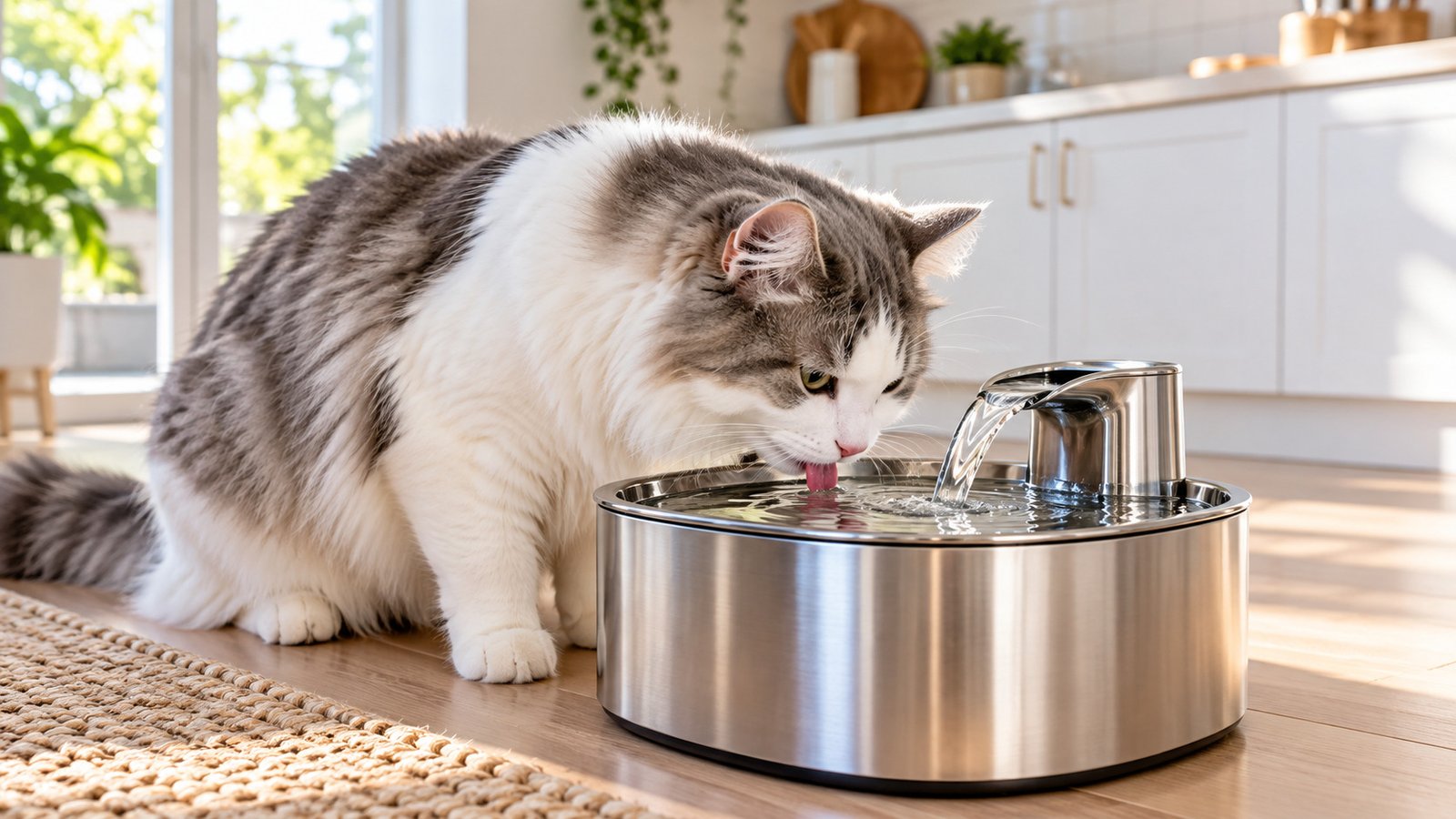
Keeping your cat hydrated is an important part of everyday pet care. Cats need access to fresh, clean water throughout the day, but some cats seem less interested in drinking from a regular water bowl. A cat water fountain offers moving water that may attract their attention and encourage them to explore their drinking area.
Among the different types available, a stainless steel cat water fountain is worth considering for its durable construction, smooth surfaces, and relatively easy cleaning. Many models include a pump, a water reservoir, and a filtration system to help keep the water circulating.
However, not every fountain is equally easy to maintain. Some have small parts that take extra time to clean, while others require frequent filter replacements or have pumps that collect debris.
In this guide, we will explain how to choose the best stainless steel cat water fountain for easy cleaning in 2026. You will learn which features matter, how to compare different models, how to maintain a fountain, and what to consider before buying one.
Whether you have one kitten, an adult cat, or a household with multiple cats, this guide will help you make a more informed decision.
Why Choose a Stainless Steel Cat Water Fountain?
Cat water fountains are available in plastic, ceramic, and stainless steel. Each material has advantages, but stainless steel is popular among pet owners who want a durable and easy-to-clean drinking solution.
Here are some reasons to consider it.
1. Smooth Surfaces Make Cleaning Easier
Stainless steel generally has a smooth, nonporous surface. This makes it easier to wipe away water residue and clean the drinking area compared with some scratched or worn surfaces.
However, stainless steel does not mean maintenance-free. Water deposits, saliva, food particles, and biofilm can still accumulate if the fountain is not cleaned regularly.
Choose a design with removable components and accessible corners so you can clean the entire unit properly.
2. Durable Construction
A well-made stainless steel fountain can withstand normal daily use. It is less likely to crack from ordinary handling than some plastic models, although its durability depends on the quality and thickness of the material.
Check whether the drinking surface, reservoir, and other exposed components are made from stainless steel or whether the product only has a stainless steel top.
3. A Useful Option for Everyday Pet Care
Cats need clean drinking water regardless of the type of bowl or fountain you choose. A fountain can make the drinking area more interesting for cats that enjoy moving water.
Still, individual preferences vary. Some cats love fountains, while others prefer a quiet, ordinary bowl. If your cat avoids a fountain, keep a clean bowl available and allow your pet to adjust gradually.
4. Potentially Less Odor Retention
Smooth stainless steel surfaces are generally easier to clean than scratched plastic surfaces, where residue may become harder to remove.
Nevertheless, odors can develop in any fountain if water is left standing, the pump is neglected, or components are not cleaned correctly.
Regular maintenance is more important than material alone.
What to Look for in the Best Stainless Steel Cat Water Fountain
Before purchasing a fountain, compare its cleaning requirements, construction, capacity, and operating costs. A fountain that looks attractive may not be the most convenient choice for your household.
1. Removable Stainless Steel Drinking Surface
Look for a fountain with a removable drinking tray or top. Being able to separate the main components makes routine washing easier.
Check the manufacturer’s instructions to understand which parts are dishwasher-safe and which require handwashing.
Do not assume that every component can go into a dishwasher simply because the product is made from stainless steel.
2. Easy-to-Disassemble Design
The pump, filter compartment, tubing, and reservoir should be accessible for maintenance.
Avoid choosing a complicated design if you want to minimize cleaning time. Small spaces can trap hair, food particles, and slime-like biofilm.
Before buying, check the product manual or demonstrations to see how easily the fountain comes apart.
3. Suitable Water Capacity
Capacity should match the number of cats using the fountain and how frequently you can refill it.
A smaller fountain may work well for one cat if you are comfortable checking the water level regularly. A larger reservoir may be more convenient for multiple cats, but it does not eliminate the need for fresh water and cleaning.
Consider these factors:
- Number of cats in your home
- Your cats’ normal drinking habits
- How often you are home to refill the reservoir
- Available counter or floor space
- Whether the fountain has a visible water-level indicator
Always follow the manufacturer’s minimum water-level instructions to protect the pump.
4. A Reliable, Replaceable Pump
The pump circulates the water and is one of the most important parts of the fountain.
Choose a model with clear pump-cleaning instructions and replacement parts that are reasonably easy to find.
A quiet pump can also be helpful if the fountain will sit in a bedroom or another quiet area. However, noise levels can change when the water level drops or the pump collects debris.
5. Easy-to-Replace Filters
Many fountains use filters to capture hair, particles, and certain impurities. Depending on the design, a filter may contain activated carbon or other materials.
Filters have different purposes, and they do not make dirty water safe automatically. They also do not replace washing the reservoir and pump.
Before buying, check:
- The price of replacement filters
- Whether the correct filters are readily available
- The manufacturer’s replacement schedule
- Whether the fountain can be disassembled without damaging the filter housing
Replacement filter costs should be included in your long-term budget.
6. Stable Base and Splash Control
A stable fountain is less likely to move when your cat drinks. A well-designed base can also help reduce spills.
If your cat enjoys playing with running water, look for a model with a suitable drinking flow and a stable reservoir.
Place the fountain on a level, water-resistant surface, away from electrical hazards.
7. Food-Contact Material Information
Check the manufacturer’s product specifications to understand which parts contact drinking water.
Do not assume that every component is stainless steel just because the product title uses that phrase. Plastic pumps, silicone seals, and other materials may still be present.
Clear product information helps you compare fountains more accurately.
Best Stainless Steel Cat Water Fountain Options to Compare in 2026
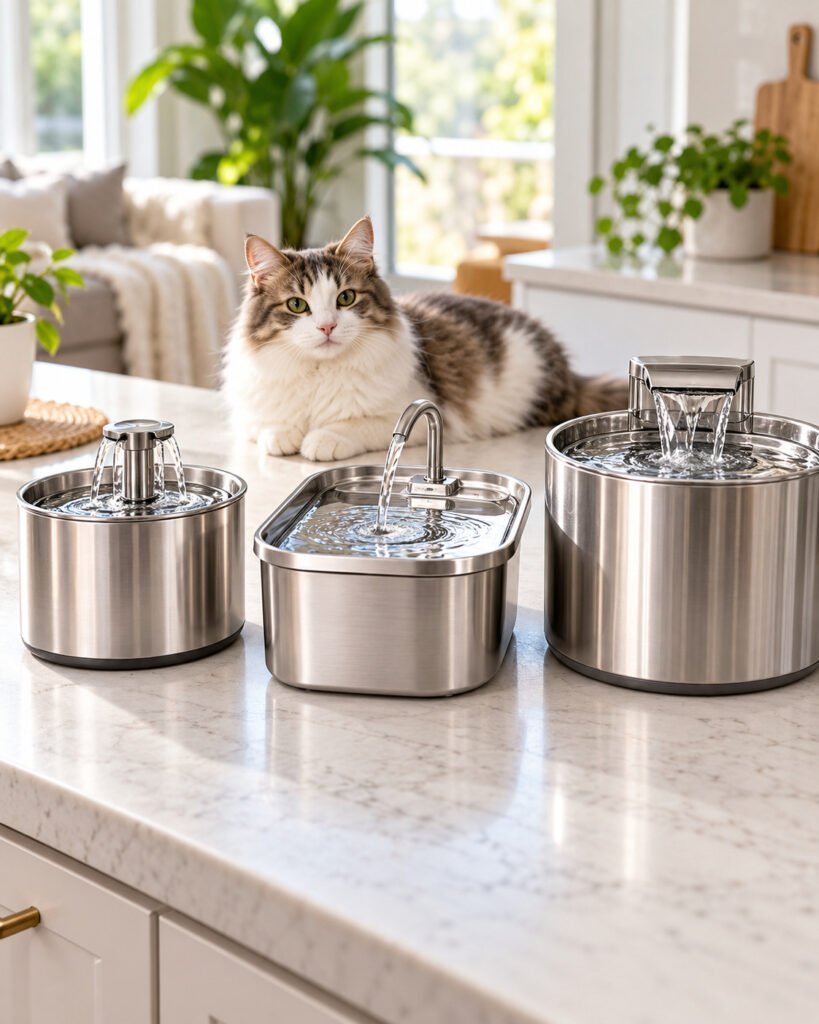
There is no single fountain that is best for every cat. The right choice depends on your budget, cleaning preferences, household size, and replacement-part availability.
Instead of relying only on marketing claims, compare the following types of products.
1. Stainless Steel Fountain With a Removable Top
This style is a good starting point for owners who want a simple cleaning routine.
Look for a drinking surface that lifts off easily and a reservoir that provides access to the areas where water collects.
Best for: Cat owners who prioritize straightforward daily maintenance.
What to check: Whether the top, reservoir, and pump compartment can be cleaned separately.
Affiliate product link: https://link.amazon/B0aFXFmWK
2. Stainless Steel Fountain With Multi-Stage Filtration
Some models use several filtration materials to capture particles and help reduce certain tastes or odors.
The exact performance depends on the filter design and the manufacturer’s specifications. Multi-stage filtration does not mean that the fountain removes every contaminant.
Best for: Owners who prefer a fountain with an integrated filter system.
What to check: Filter availability, replacement cost, installation instructions, and cleaning requirements.
Affiliate product link: https://link.amazon/B09q2DivK
3. Stainless Steel Fountain for Multiple Cats
Households with several cats may benefit from a larger reservoir and a drinking area that is comfortable for more than one pet.
Capacity alone should not determine your choice. Consider how often you can refresh the water, how much space the unit needs, and whether all your cats are comfortable using the same fountain.
Best for: Multi-cat households.
What to check: Actual reservoir capacity, refill convenience, pump performance, and the availability of replacement components.
Affiliate product link: https://link.amazon/B0iV3Xzyz
4. Compact Stainless Steel Fountain for Small Spaces
A compact fountain may suit apartments, small kitchens, or homes with limited floor space.
The trade-off is that a smaller reservoir may require more frequent refilling.
Best for: Owners with one cat or limited space.
What to check: Dimensions, water capacity, pump access, and the location of the power cable.
How to Compare Different Models
When comparing products, use a consistent checklist rather than relying only on star ratings.
| Feature | What to look for |
|---|---|
| Material | Clearly specified stainless steel drinking surfaces |
| Cleaning | Removable parts and accessible pump compartment |
| Capacity | Suitable for your number of cats |
| Filtration | Available replacement filters and clear instructions |
| Maintenance | Simple pump cleaning and easy reassembly |
| Noise | Manufacturer information and credible owner feedback |
| Running costs | Filters, replacement pumps, and electricity |
| Warranty | Clear warranty and customer support information |
Product prices, availability, and specifications can change. Confirm these details on the seller’s website before publishing a product comparison.
How to Clean a Stainless Steel Cat Water Fountain
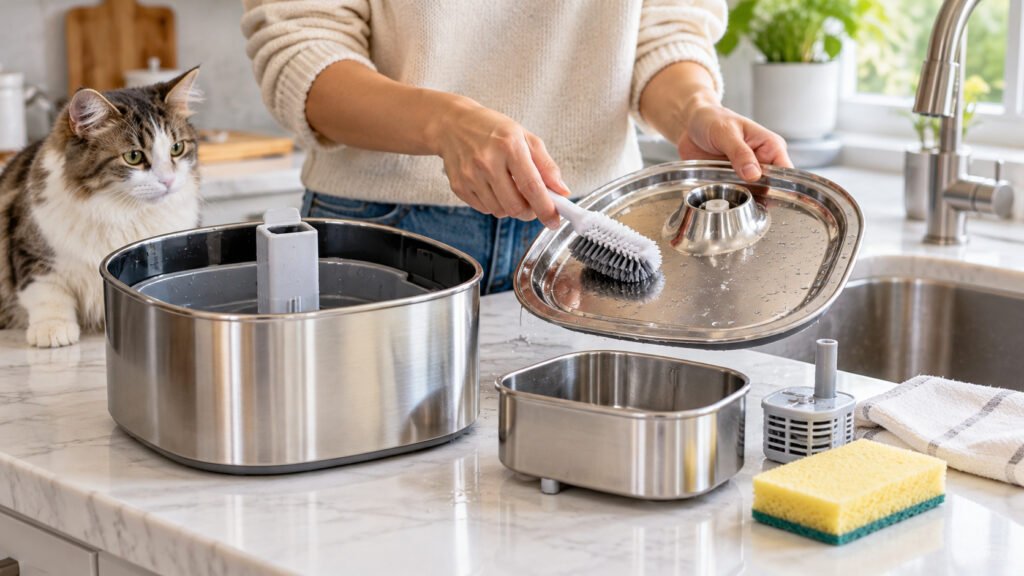
Even an excellent fountain needs regular cleaning. A consistent routine helps prevent residue from building up and keeps the drinking area pleasant for your cat.
Follow the manufacturer’s instructions first, particularly for electrical components and filter handling.
Step 1: Unplug the Fountain
Always disconnect the fountain from its power source before cleaning or handling the pump.
Never immerse a pump or electrical connector in water unless the manufacturer explicitly identifies that component as waterproof and provides instructions for doing so.
Step 2: Empty the Reservoir
Pour out the remaining water and remove the drinking tray, reservoir, and other detachable components.
Discard old water rather than simply topping it up.
Step 3: Wash the Removable Components
Use warm water and a mild dish soap suitable for washing food-contact items. Clean the drinking surface, reservoir, and removable parts using a soft sponge or brush.
Pay attention to corners, grooves, and the underside of the drinking tray.
Avoid steel wool and abrasive cleaners that can scratch the surface. Rinse thoroughly so no soap residue remains.
Step 4: Clean the Pump
Follow the pump manufacturer’s disassembly instructions.
Hair and debris can collect around the intake, impeller, and small openings. Use an appropriate soft brush to remove buildup without damaging the components.
Never force a part open or use a sharp object that could damage the pump.
Step 5: Handle the Filter Correctly
Follow the instructions supplied with the particular filter. Some filters require rinsing before use, while others have different preparation requirements.
Replace filters according to the manufacturer’s schedule or sooner when required by their condition and instructions.
A dirty filter should not be treated as a substitute for cleaning the fountain.
Step 6: Rinse and Reassemble
Rinse all washable parts thoroughly. Reassemble the fountain according to the manual and fill it with fresh water.
Make sure the pump has the required water level before switching the fountain back on.
Step 7: Check for Leaks and Unusual Noise
Once the fountain is running, confirm that the water circulates properly and the unit is stable.
If you notice an unusual noise, weak flow, leakage, or a burning smell, switch it off and investigate according to the manufacturer’s instructions.
Do not continue operating a damaged electrical appliance.
How Often Should You Clean a Cat Water Fountain?
Cleaning frequency depends on the fountain design, the number of cats, the environment, and the manufacturer’s recommendations.
The following schedule is a practical starting point, not a universal rule.
| Maintenance task | Suggested routine |
|---|---|
| Check water level and appearance | Daily |
| Refresh water | Daily, or sooner if dirty |
| Wash drinking surfaces and reservoir | At least weekly, or more often if needed |
| Inspect and clean the pump | According to the manual, often during regular cleaning |
| Inspect and replace filters | According to the filter instructions |
| Check cable, seals, and parts | Regularly and whenever a problem appears |
If the water becomes cloudy, develops an unpleasant smell, or contains visible debris, empty the fountain and clean it instead of waiting for the next scheduled wash.
Homes with multiple cats may need more frequent maintenance.
Stainless Steel vs. Plastic vs. Ceramic Cat Fountains
Choosing the right material is an important part of buying a cat fountain.
Stainless Steel
Advantages:
- Smooth, generally nonporous surfaces
- Easy to wipe and wash
- Good durability when properly made
- Often suitable for owners who prefer a simple, modern design
Potential disadvantages:
- Some models cost more than basic plastic fountains
- Water spots may appear if the surface is not dried
- The pump and other components still require regular maintenance
Plastic
Advantages:
- Often affordable
- Lightweight and available in many designs
- May offer a wide range of shapes and features
Potential disadvantages:
- Scratches can make thorough cleaning more difficult
- Some models may develop visible wear over time
- Plastic components still need frequent washing
Ceramic
Advantages:
- Often attractive in home interiors
- Smooth glazed surfaces can be easy to clean
- Heavier designs may remain stable during use
Potential disadvantages:
- Can chip or break if dropped
- May be heavier to move and wash
- Replacement components depend on the model
There is no universally best material. Choose one that suits your cat, cleaning habits, budget, and available space.
Common Mistakes to Avoid When Buying a Cat Water Fountain
Buying Only Because of the Price
A low initial price may not reflect the total cost of ownership. Replacement filters, pumps, and other parts can add up.
Compare the purchase price with the expected maintenance costs before making a decision.
Ignoring Replacement Filter Availability
A fountain may seem convenient until you discover that its filters are difficult to find.
Before buying, check the exact filter model and whether replacements are available from a reliable seller.
Assuming Stainless Steel Means No Bacteria
Stainless steel is not self-cleaning. Water, saliva, and debris can still support biofilm buildup.
Wash the fountain regularly, inspect the pump, and provide fresh water.
Choosing a Fountain That Is Too Complicated
A fountain with many small components may require more time to disassemble and clean.
If easy maintenance is your priority, a simpler design with accessible parts may be a better fit.
Forgetting Your Cat’s Preferences
Not every cat likes moving water, and some cats may be cautious around the sound of a pump.
Introduce the fountain gradually. Keep a familiar water bowl available so your cat always has an alternative.
Placing the Fountain in an Inconvenient Location
Avoid placing a fountain next to a litter box or in a location where food debris regularly falls into the water.
Choose a quiet, accessible area with a stable, water-resistant surface and a safe electrical connection.
Tips to Encourage Your Cat to Drink More Water
A fountain can be one part of a good hydration routine, but it is not the only option.
Here are several practical ideas:
- Provide fresh water every day.
- Keep drinking water away from the litter box.
- Try placing water in a quiet area where your cat feels comfortable.
- Offer a separate clean water bowl if your cat dislikes fountains.
- Ask your veterinarian whether wet food may be appropriate for your cat.
- Monitor changes in your cat’s usual drinking and urination habits.
A sudden increase or decrease in drinking can sometimes indicate a health problem. Contact your veterinarian if you notice a persistent change, particularly alongside changes in appetite, weight, urination, or energy.
A water fountain should not be used to diagnose or treat a medical condition.
Are Stainless Steel Cat Water Fountains Worth It?
For many households, a stainless steel cat water fountain can be a practical purchase. Its smooth drinking surface, durability, and cleaning convenience may make it attractive to owners who want a long-lasting alternative to a basic bowl.
However, the best value depends on more than material.
Consider the cost of replacement filters, the ease of pump maintenance, the fountain’s capacity, the manufacturer’s warranty, and whether your cat actually enjoys drinking from it.
If your cat prefers a regular bowl, there is no need to insist on a fountain. The priority is always access to clean, fresh water.
Frequently Asked Questions
1. Is stainless steel better than plastic for a cat water fountain?
Stainless steel has a smooth, nonporous surface that is generally easy to clean and can be durable. Plastic may be more affordable and lightweight. The condition of the surface and the cleaning routine matter whichever material you choose.
2. How often should I clean a stainless steel cat fountain?
Check the water daily and refresh it regularly. Wash the fountain at least weekly as a starting point, and clean it more often if it becomes dirty. Follow the manufacturer’s instructions for pump maintenance and filter replacement.
3. Do stainless steel cat fountains need filters?
Not every fountain uses the same filtration system. Some models use replaceable filters, while others have different designs. Check the product specifications and understand that filtration does not replace regular washing.
4. Can I put a stainless steel cat fountain in the dishwasher?
Some stainless steel components may be dishwasher-safe, but others are not. The pump, electrical components, seals, and filter housing may require separate care. Always follow the manufacturer’s instructions.
5. Are cat water fountains noisy?
Noise varies by pump design, water level, and maintenance condition. A fountain can become louder when the water level is too low or debris affects the pump. Look for manufacturer noise information and credible reviews before purchasing.
6. Is a stainless steel fountain suitable for multiple cats?
It can be, provided its capacity and drinking area suit your household. Multiple cats may require more frequent refilling and cleaning. Offering additional water stations can also help.
7. How much does a stainless steel cat water fountain cost?
Prices vary according to capacity, materials, filtration, pump design, and brand. Check current retailer listings rather than relying on an old price estimate. Include ongoing filter and replacement-part costs when comparing options.
8. Will a cat water fountain prevent dehydration?
No fountain can guarantee that a cat will drink enough water. Some cats prefer bowls, and changes in drinking habits can have medical causes. Provide fresh water and contact a veterinarian if you are concerned about your cat’s hydration.
Final Verdict
The best stainless steel cat water fountain for easy cleaning is one that combines a smooth drinking surface with removable components, a maintainable pump, suitable water capacity, and readily available replacement parts.
For a single cat, a compact and easy-to-clean design may be sufficient. For a multi-cat home, a larger reservoir and convenient maintenance may be more important.
Before buying, compare the product specifications, filter costs, cleaning instructions, and warranty. Choose a fountain that fits your home and your cat’s preferences rather than relying on marketing claims alone.
A well-maintained fountain can make providing fresh water more convenient, but regular cleaning and monitoring your cat’s drinking habits remain essential.
Ready to compare your options? Review the stainless steel cat water fountains linked in this guide and choose the model that best matches your cleaning routine and budget.