
Disclosure: This post contains affiliate links. If you click a link and make a purchase, we may earn a small commission at no extra cost to you. We only recommend products we believe can be helpful.
If your big dog struggles to stand up, lies down slowly, or seems stiff after a nap, you are probably worried. You want to help, and you want to do it the right way.
Hip dysplasia is one of the most common joint problems in large dogs. It can make everyday life harder, and that includes sleep. The right orthopedic dog bed for hip dysplasia matters more than most people think.
In this guide, you will learn what hip dysplasia is, why an orthopedic bed helps, what to look for before you buy, and which types of beds work best for large breeds. We also cover common mistakes and answer frequently asked questions.
Genetics play a big role. Weight, growth rate, diet, and exercise can also affect how the condition develops.
Common Signs of Hip Dysplasia
Watch for these signs in your dog:
- Difficulty getting up from lying down
- Stiffness, especially in the morning
- “Bunny hopping” when running
- Reluctance to climb stairs or jump into the car
- Swaying or wobbly walk in the back legs
- Less interest in play or walks
- Muscle loss in the back legs
- Clicking or popping sounds from the hips
If you notice any of these signs, book a vet visit. A vet can confirm the problem with an exam and X-rays, then suggest the right care.
Why Your Dog’s Bed Matters So Much
Dogs sleep a lot. Adult dogs often sleep 12 to 14 hours a day, and some large breeds sleep even more. That is many hours of pressure on the joints.
For a dog with sore hips, a poor bed can make things worse. A thin, flat bed lets heavy hips sink into the hard floor beneath. A bed that is too soft can make it hard for your dog to get up, because the joints have nothing firm to push against.
A good orthopedic bed can help by:
- Spreading out body weight so there is less pressure on the hips, elbows, and shoulders
- Giving firm, even support so the body stays in a natural position
- Making it easier to stand up and lie down
- Keeping your dog off cold, hard floors, since cold can make stiff joints feel worse
- Encouraging better rest, which supports your dog’s overall wellbeing
An orthopedic bed will not cure hip dysplasia. Think of it as one helpful part of a bigger care plan that your vet guides.
What Does “Orthopedic” Really Mean?
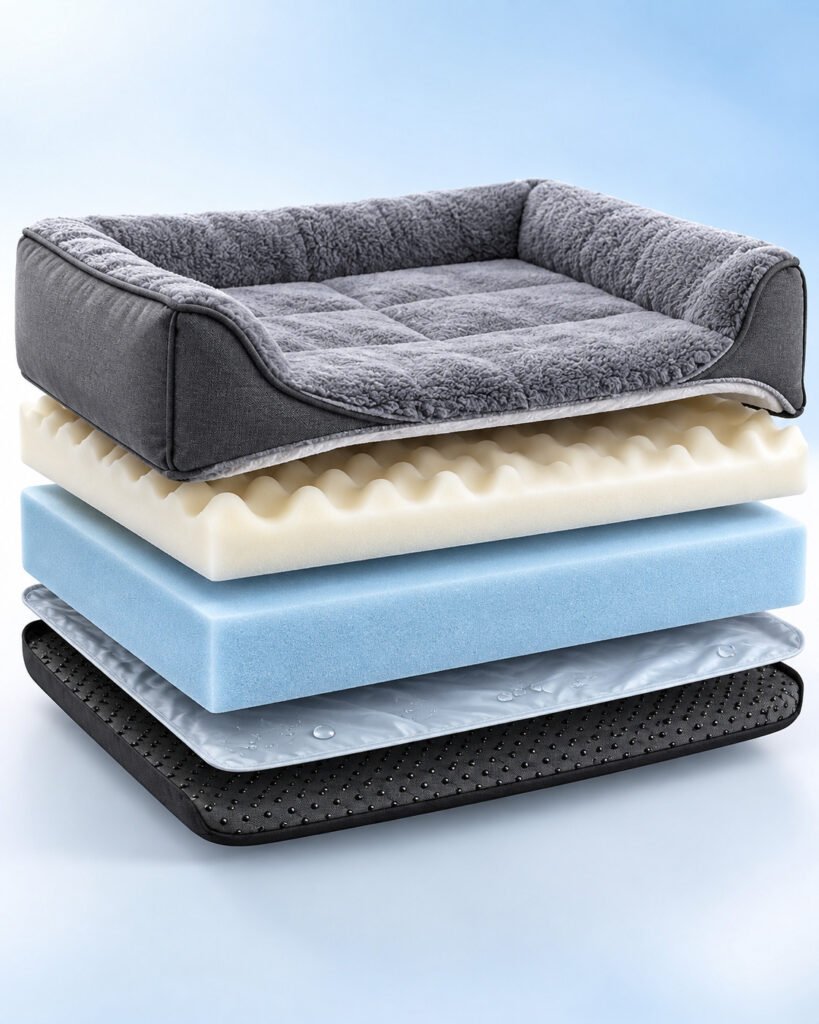
You will see the word “orthopedic” on many dog beds. Unfortunately, it is not a regulated term. Some companies use it for beds that have only a thin layer of foam.
A real orthopedic dog bed should have:
- A thick, supportive foam base (usually at least 4 inches for large dogs)
- Foam that bounces back and does not flatten after a few weeks
- A removable, washable cover
- A size that fits your dog’s full body
If the product page does not tell you the foam type and thickness, be careful. Good brands share these details clearly.
7 Things to Look for in an Orthopedic Dog Bed for Hip Dysplasia
1. High-Quality Foam
Foam is the heart of the bed. The most common types are:
Memory foam (viscoelastic foam): It molds to your dog’s body shape and spreads out pressure. Many owners of dogs with joint pain like it. The downside is that some memory foam can feel warm and may be slow to bounce back.
Orthopedic support foam (high-density foam): This is firmer and springs back quickly. It is a great choice for very heavy dogs because it resists flattening.
Egg-crate foam: It looks bumpy, like an egg carton. It is usually cheaper but often too thin and soft for large dogs with hip problems. It can work as a top layer but is rarely enough on its own.
Shredded foam or polyfill: These are soft and fluffy, but they tend to clump and flatten. They are not ideal as the main support for sore hips.
Best choice for most large breeds: a solid layer of high-density foam, often with a memory foam top layer for comfort.
2. The Right Thickness
For large breeds, thickness matters. A bed that is too thin lets your dog “bottom out.” That means the hips press through the foam and touch the floor.
As a general guide:
- Large dogs (50 to 90 lbs): look for 4 inches or more
- Giant dogs (90 lbs and up): look for 5 to 7 inches or more
Heavier dogs need thicker, denser foam.
3. A Size That Fits Your Dog’s Whole Body
Measure your dog while they are lying in their favorite sleeping position. Measure from nose to the base of the tail, and add about 6 to 12 inches.
Many large dogs stretch out when they sleep. The bed should support the full body, including the hips and the back legs. If a back leg hangs off the bed onto the floor, the bed is too small.
4. Easy Entry and Exit
Dogs with hip dysplasia often find it hard to step over high edges. Look for a bed with:
- A low front edge or an open side
- A flat, bolster-free design (or a bolster only on one or two sides)
- A non-slip bottom so the bed does not slide when your dog gets up
A bed with high bolsters on all sides looks cozy, but it can be a challenge for a stiff dog to climb in and out of.
5. A Washable, Durable Cover
Large dogs shed, drool, and sometimes have accidents. This is especially true for older dogs. Pick a bed with:
- A removable cover you can machine wash
- Strong fabric that handles claws and heavy use
- A waterproof liner under the cover to protect the foam from spills
A waterproof liner can double the life of the bed.
6. A Non-Slip Base
Hip pain and slippery floors do not mix. If the bed slides on tile or hardwood when your dog tries to stand, it can be a safety risk. A grippy bottom keeps the bed in place and helps your dog feel secure.
7. Good Warranty and Return Policy
Large orthopedic beds are an investment. Look for a brand that offers a solid warranty and a fair return policy. It is common to need a few days to see if your dog likes the bed.
Types of Orthopedic Beds for Large Breeds
Not every dog likes the same style. Here are the main options.
Flat Memory Foam Mattress Beds
These look like a small mattress. They are great for dogs who sprawl out, and they make it easy to step on and off.
Best for: Dogs with mobility problems, dogs who sleep stretched out, and giant breeds.
Bolster Beds with Orthopedic Foam
These have raised sides where dogs can rest their head or lean. Many dogs love them. Choose one with a lower bolster or a “cutout” front so your dog can enter easily.
Best for: Dogs who like to curl up or rest their chin on something.
Elevated (Cot-Style) Beds
These raise your dog off the floor on a frame, with a breathable fabric surface. They keep dogs cool, which is helpful in warm climates. However, they do not give the cushioned support of foam. Many vets suggest a foam bed for dogs with sore joints, so consider adding a foam topper to a cot or choosing foam instead.
Best for: Hot weather or outdoor use (as a secondary bed).
Cooling Gel Memory Foam Beds
Some memory foam traps heat. Gel-infused or cooling foam beds are designed to feel cooler. They can be a good fit for thick-coated breeds like Newfoundlands, Bernese Mountain Dogs, and Saint Bernards.
Best for: Dogs that overheat easily, and people who live in warm regions.
Heated Orthopedic Beds
Some dogs with stiff joints feel better when they are warm. Heated beds exist, but safety is key. Only use pet-safe products designed for dogs, follow the instructions, and ask your vet first.

Top Picks: Best Orthopedic Dog Bed for Hip Dysplasia in Large Breeds
Below are three types of beds that many owners of large dogs look for. Before you buy, always check the current size, foam thickness, weight rating, and reviews on the product page.
Pick #1: Best Overall – Thick Orthopedic Memory Foam Bed with Washable Cover
This style combines a dense foam base with a memory foam top layer. It gives strong support for heavy hips while still feeling soft. Look for one with a waterproof liner and a washable cover.
Why it works for hip dysplasia:
- Spreads out pressure across the hips and joints
- Foam stays supportive for heavy dogs
- Cover is easy to clean
Things to keep in mind:
- Quality beds cost more up front
- Large sizes are bulky and heavy to move
👉 Best Overall Orthopedic Memory Foam Dog Bed – https://link.amazon/B0emoMhNO
Pick #2: Best for Giant Breeds – Extra-Large Flat Orthopedic Mattress Bed
If you have a Great Dane, Mastiff, or Saint Bernard, you need a big bed with extra thick foam. Extra-large mattress-style beds give your dog room to stretch out, and the flat design makes it easy to get on and off.
Why it works for hip dysplasia:
- Plenty of space for the whole body
- No high edges to climb over
- Built for heavier weights
Things to keep in mind:
- Measure your space first, since these beds are large
- Check the weight rating on the product page
👉Large Orthopedic Dog Bed for Giant Breeds – https://link.amazon/B0iCLaP5D
Pick #3: Best for Hot Climates – Cooling Gel Memory Foam Bed
Many dogs with joint pain still get hot at night. A gel-infused or cooling foam bed can help them stay comfortable while still getting the support they need.
Why it works for hip dysplasia:
- Supportive foam for sore joints
- Designed to reduce heat buildup
- Good for thick-coated breeds
Things to keep in mind:
- Cooling effects vary by product, so read customer reviews
- Still check foam thickness before buying
Bonus: Orthopedic Bed Topper or Pet Ramp
If your dog loves their current bed, you could add an orthopedic foam topper. Another helpful add-on is a ramp or steps for the car or couch, which reduces jumping.
How to Choose the Right Bed for Your Dog (Quick Checklist)
Use this simple list before you buy:
- ✅ Did I measure my dog while they were lying down?
- ✅ Is the foam at least 4 inches thick (more for giant breeds)?
- ✅ Does the product page clearly explain the foam type?
- ✅ Is the cover removable and washable?
- ✅ Is there a waterproof liner?
- ✅ Does the bed have a non-slip bottom?
- ✅ Can my dog easily step onto it?
- ✅ Does it fit my dog’s weight rating?
- ✅ Is there a return policy or warranty?
Helpful Tips for Dogs with Hip Dysplasia
A good bed is a great start, but it works best alongside other care. Always follow your vet’s advice. Here are some general ideas that many vets discuss with owners:
Keep Your Dog at a Healthy Weight
Extra weight puts more stress on the joints. Ask your vet what a healthy weight is for your dog and how to reach it safely.
Choose Gentle Exercise
Short, steady walks and low-impact activities like swimming are often suggested. Avoid long runs, sharp turns, and lots of jumping unless your vet says it is safe.
Use Non-Slip Surfaces
Slippery floors are hard on weak hips. Rugs, runners, or yoga mats in key areas can help your dog feel steady. Some owners also use non-slip dog socks or paw grips.
Help with Stairs and Cars
Ramps and steps make it easier to get into the car or onto the couch. This lowers the risk of strain from jumping.
Ask About Supplements and Treatments
Your vet may talk about joint supplements, pain relief, physical therapy, laser therapy, or in some cases, surgery. Never give your dog human pain medicine, as many are dangerous for dogs.
Keep Up with Vet Visits
Hip dysplasia can change over time. Regular check-ups help your vet adjust the plan as your dog’s needs change.
Common Mistakes to Avoid When Buying an Orthopedic Dog Bed
Mistake 1: Buying based only on the word “orthopedic.” Always check the foam type and thickness.
Mistake 2: Choosing a bed that is too small. When in doubt, size up. A bed that is too small defeats the purpose.
Mistake 3: Picking a bed that is too soft. Sinking into a very soft bed can make it hard for your dog to get up. Joints need firm support.
Mistake 4: Ignoring the cover. A cover that is hard to remove or wash will become a headache fast.
Mistake 5: Skipping the adjustment period. Some dogs need a few days to get used to a new bed. Place it in their favorite spot, add a familiar blanket, and use treats to make it inviting. Do not force your dog onto it.
Mistake 6: Putting the bed in a drafty or noisy area. Place it in a quiet, warm spot away from cold drafts.
How Long Does an Orthopedic Dog Bed Last?
It depends on the quality of the foam, your dog’s weight, and how often it is used. A well-made bed for a large dog may last several years. Signs that it is time to replace the bed include:
- Visible dips or permanent flat spots
- Foam that no longer bounces back
- Your dog seems less comfortable than before
- Tears or damage to the foam or liner
Rotating or flipping the bed (if designed for it) and washing the cover regularly can help it last longer.
Frequently Asked Questions (FAQs)
What is the best bed for a large dog with hip dysplasia?
The best bed usually has thick, high-quality orthopedic foam (4 inches or more), a washable cover, a non-slip base, and a size big enough for your dog to stretch out. Many owners choose memory foam or high-density foam beds.
Is memory foam good for dogs with hip dysplasia?
Many owners and vets like memory foam because it spreads out pressure and supports joints. For very heavy dogs, a bed with a firmer foam base plus a memory foam top layer is often a better choice than memory foam alone.
How thick should an orthopedic dog bed be for a large dog?
For large dogs, 4 inches or more is a good starting point. For giant breeds, look for 5 to 7 inches or more. Thicker, denser foam is better for heavier dogs.
Can an orthopedic bed cure hip dysplasia?
No. Beds do not cure hip dysplasia. They can help your dog rest more comfortably, but treatment and management should come from your veterinarian.
Are raised or elevated dog beds good for hip dysplasia?
Elevated beds keep dogs cool and off the floor, but most are not very cushioned. Many dogs with sore joints do better on a thick foam bed. You can add a foam pad on top of a cot-style bed for extra comfort.
Should I get a bed with bolsters?
It depends on your dog. Some dogs love to rest their head on a bolster. But high bolsters can make it hard for a stiff dog to get in and out. A low bolster or a flat bed is usually easier.
How do I know if my dog likes the new bed?
Signs include sleeping on it often, stretching out comfortably, getting up more easily, and seeming more relaxed. If your dog avoids it, try a different location, add a familiar blanket, or consider another style.
How often should I wash the dog bed?
Most people wash the cover every one to two weeks, or more often if needed. Check the care label. Do not put the foam itself in the washing machine unless the manufacturer says it is safe.
What if my dog is a puppy with signs of hip problems?
Talk to your vet early. Young dogs can show signs of hip dysplasia, and early care may help. Get the vet’s advice before choosing any bed or exercise plan.
Is it okay to buy a used orthopedic dog bed?
It is better to buy new. Used foam can be worn out, flat, or hold odors and bacteria, which means less support for your dog.
Final Thoughts
Living with hip dysplasia is not easy for your dog or for you. But small changes can make daily life more comfortable. A supportive orthopedic bed gives your large dog a place to rest well, take pressure off sore joints, and wake up feeling better.
When you shop, remember the key points:
- Choose thick, high-quality foam
- Pick the right size for your dog’s full body
- Make sure it is easy to get on and off
- Look for a washable cover and non-slip base
- Work with your vet for the full care plan
Your dog gives you loyalty and love every day. A good bed is a simple, caring way to give some of that comfort back.
Have you found a bed that works for your large dog? Share your tips in the comments below. Your experience could help another dog owner!